modtector Documentation
Welcome to modtector, a high-performance RNA modification detection tool built with Rust.
Welcome
Welcome to the modtector documentation! This is your starting point for learning about our high-performance RNA modification detection tool.
Getting Started
New to modtector? Start with the Overview to understand the tool’s capabilities and browse the documentation structure
Need installation help? Check the Installation Guide
Ready to get started? Follow the Quick Start Guide
Quick Links
Installation - Detailed installation instructions
Quick Start Guide - Get started with modtector
User Guide - Comprehensive usage guide
Command Reference - Complete command documentation
Examples - Practical examples and tutorials
Troubleshooting - Common issues and solutions
Contributing - How to contribute to modtector
Workflow Overview
modtector provides a complete workflow from raw data to evaluation results:
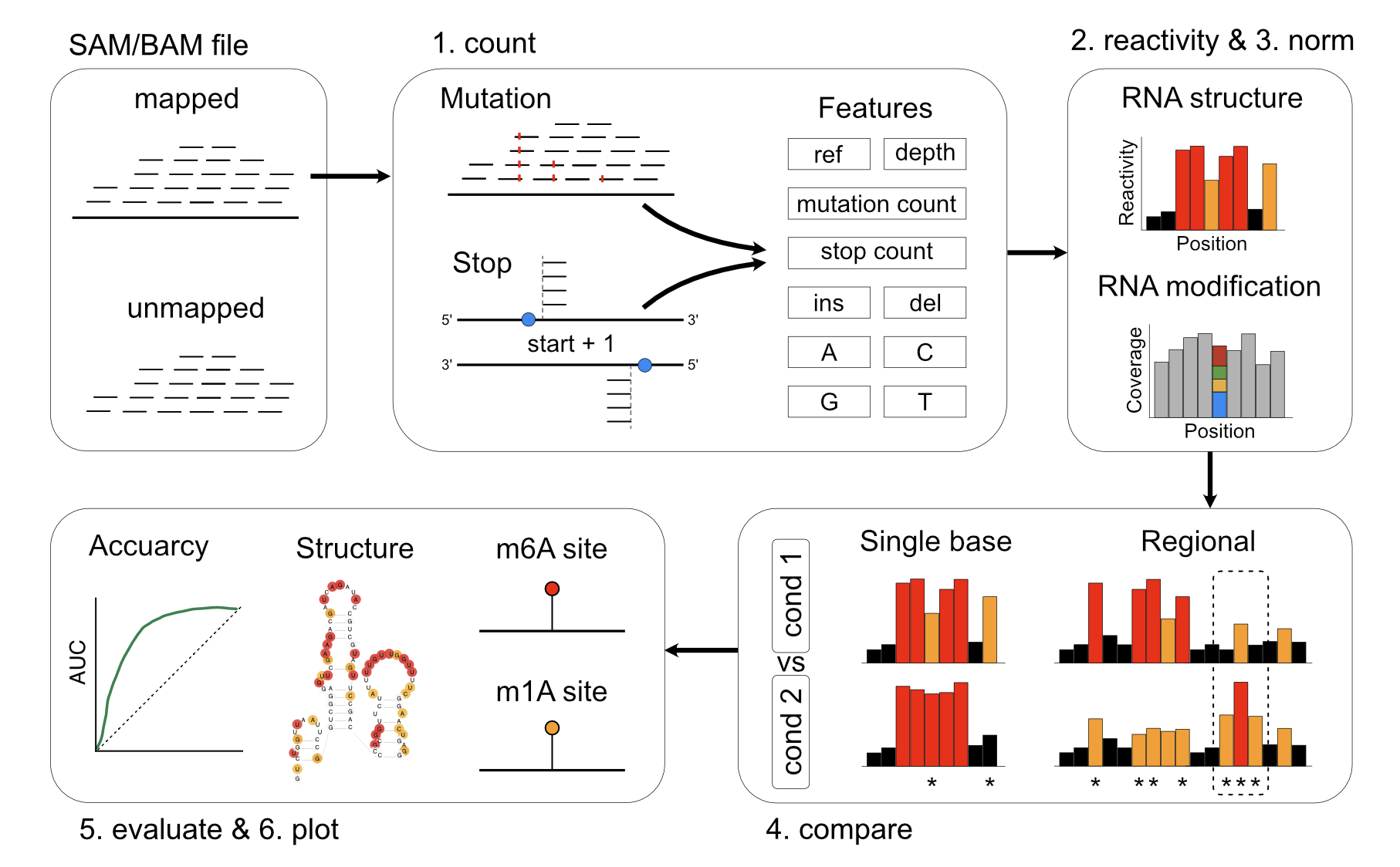
Data Input: BAM files (modified/unmodified samples), FASTA reference sequences, secondary structure files
Statistical Analysis: Pileup traversal, counting stop and mutation signals
Data Normalization: Signal filtering, outlier handling, background correction
Comparative Analysis: Modified vs unmodified sample comparison, identifying modification sites
Reactivity Calculation: Calculate signal differences, generate reactivity data
Duet Analysis: Sliding-window inference of dynamic ensembles from normalized reactivity and read-level co-variation
Visualization: Generate signal distribution plots and reactivity plots
Accuracy Assessment: Performance evaluation based on secondary structure
Version Information
Current Version: v0.15.4
Release Date: 2026-02-08
License: MIT License
Project Links
GitHub Repository: https://github.com/TongZhou2017/modtector
Crates.io: https://crates.io/crates/modtector
Documentation: https://modtector.readthedocs.io/
Recent Highlights
PCR Bias Correction: Chi-Square distribution-based depth correction (
correctcommand)Base Quality Filtering: Per-base quality filtering for mutation detection (
--min-base-qual)Extended Format Support: Support for multiple input formats in
convertcommand (rf-rctools, shapemapper2, icSHAPE-rt, bedgraph, etc.)Zarringhalam Remap Improvements: Uses actual maximum values instead of fixed 1.0 for better high-value region mapping
Distribution-Based K-Factor Prediction: Advanced k-factor prediction method using statistical distribution analysis
Batch Processing: Process multiple BAM files sequentially with glob patterns
Single-cell Unified Processing: Unified processing with cell label extraction for 2-3x performance improvement
Example Dataset
To help you quickly evaluate modtector, we provide a minimal example dataset available at Zenodo (10.5281/zenodo.17316476). This dataset contains a small subset of data that can be processed quickly to demonstrate modtector’s functionality.
Quick Start with Example Data
Download and extract the example dataset:
wget https://zenodo.org/record/17316476/files/modtector_example_dataset.zip
unzip modtector_example_dataset.zip
cd modtector_example_dataset
Run the example script:
bash test_modtector_v0.10.0.sh
This will execute a complete workflow on the example data, including:
Pileup processing of BAM files
Reactivity calculation with multiple methods
Data normalization
Duet sliding-window ensemble decomposition using normalized reactivity and BAM co-variation
Visualization generation
Accuracy evaluation
The results will be organized in the signal_v0.5.6/ directory with subdirectories for each processing step.
Support
For questions, issues, or contributions, please refer to the Contributing Guide or open an issue on the GitHub repository.
Citation
If you use modtector in your research, please cite:
[Add citation information when available]